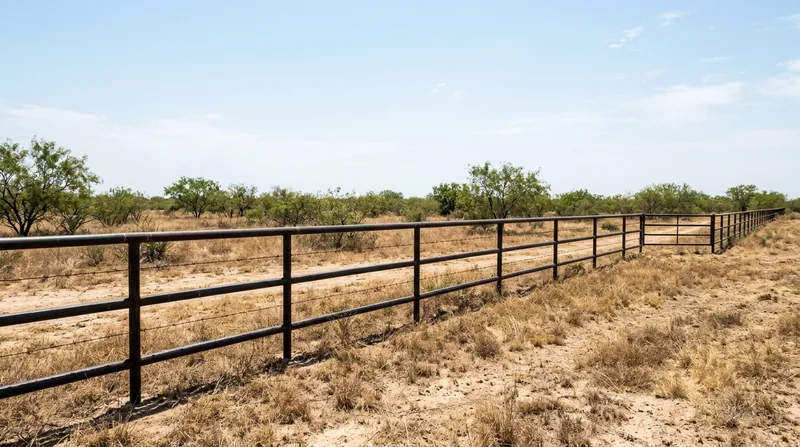




Farm fence installation in Laredo means running straight lines across brush country, setting posts deep into caliche, and bracing corners to hold against South Texas wind and the wear of livestock and equipment. Across Webb, Zapata, Jim Hogg, Duval and La Salle counties, ranch properties face relentless sun that grays wood and fades vinyl, 100-degree summers that dry and crack materials, and spring thunderstorms with straight-line gusts that test every brace and gate. Whether you are fencing pasture for horses, cattle, or game, or securing perimeter on acreage around Rio Bravo, El Cenizo, Zapata or Freer, the fence must stand for years without constant repair. We install ranch rail, no-climb horse fence, field wire, pipe and high game fencing with the crew that does the work, not a call center, and we size gates for trailers and equipment because we know what a working ranch demands.
Why Ranch and Farm Fencing Matters in South Texas Brush Country
Property in Laredo and the surrounding counties sits on flat to gently rolling caliche and sandy clay loam, often with pockets of shrink-swell clay that makes post holes hard to dig and shallow-set posts lean over time. Mesquite, live oak and huisache grow thick, and the open land between structures demands fencing that holds livestock, defines property lines, and survives the combination of UV exposure, moisture at the ground line, and the occasional tropical storm remnant. A fence that fails in this climate is not just an inconvenience, it is a liability and a loss of control over your own land.
- Posts set in concrete, not tamped, resist heave and lean on caliche and clay soils.
- No-climb horse fence and field wire contain livestock and game without the weight and cost of solid board.
- Pipe and high game fencing on acreage hold deer, hog and exotic game, and stand up to impact and rubbing.
- Corner bracing and proper post spacing keep long runs straight even in straight-line wind and under the weight of animals and equipment.
- Gates sized for trailers, trucks and implements allow you to move equipment and livestock without dismantling the fence.
A well-built ranch fence on properly spaced and braced posts protects your investment and saves you the cost of chasing loose stock and repairing damage to your property and your neighbors' land.
Local context: Webb County and the surrounding counties have no statewide farm or ranch fencing code, but your county or municipal building department may require a setback from the property line or a corner-visibility easement if the fence is near a public right-of-way. Call ahead or have us verify before we stake the line. Deed restrictions and ranch covenants also govern material and height on some properties, so review your deed or contact your county clerk if you are unsure.
How We Install Farm and Ranch Fencing Across South Texas
Every job starts with a site walk to understand the terrain, soil type, existing structures, and what the fence needs to contain or exclude. We mark the line with you, call 811 for utility locates as required by Texas law, and then set posts, install stringers or wire, and hang gates. On brush-country acreage, we work with long runs over uneven ground, use anti-sag bracing on tall fences, and set every post in concrete so it stays plumb through the heat and the occasional storm surge in low arroyos.
- We walk the property with you to confirm the fence line and identify obstacles, water crossings, and gate locations.
- We call 811 and mark all underground utilities before we dig the first post hole.
- We dig post holes to depth, set posts in concrete, and allow cure time before we install stringers or wire.
- We install rail, wire, or pipe using proper spacing and tension, with bracing at corners and at intervals on long runs.
- We hang gates with self-closing and self-latching hardware, and size them for your equipment and livestock.
- We inspect the completed fence with you and explain maintenance, including what to watch for in hard sun and heat.
On a typical ranch job from Laredo to Hebbronville, we plan for weather, soil conditions, and the time it takes to set posts properly, so the fence does not shift or sag over the first few seasons.
Example: A 40-acre pasture near Encinal with no-climb horse fence on 6-foot centers and three gates for equipment and livestock may take 5 to 7 working days, depending on soil hardness and gate complexity. Posts are set 3 feet deep on caliche, and corners are braced with diagonal cross-bracing to resist wind and animal pressure. We also install a small maintenance gate in one corner so you can access the interior without opening the main gates.
| Approach | Description | Best for |
|---|---|---|
| Ranch Rail | Horizontal 2x6 or 2x8 boards on 4x4 posts, pressure-treated or cedar, set 6 feet apart. | Horses, cattle, and high-visibility perimeter on acreage. Durable in South Texas sun but requires staining every 3 to 5 years. |
| No-Climb Horse Fence | Welded wire mesh with 1x2 inch openings, hung on posts, galvanized or powder-coated. Lightweight and low-maintenance. | Horses, goats, and small livestock. Resists climbing and does not splinter. Ideal for acreage where visibility is not a concern. |
| Field Wire and Barbed Wire | Woven or smooth wire on posts with tension bands and stretcher bar. Barbed wire adds a deterrent for cattle and game. | Cattle, hog, and game containment on large acreage. Cost-effective over long runs and easily repaired after storm damage. |
| Pipe Fencing | Welded steel pipe, galvanized or powder-coated, on 4x4 posts or pipe sleeves. Heavy-duty and impact-resistant. | High-traffic areas, equipment storage, and game ranches. Withstands rubbing, climbing, and vehicle impact without damage. |
| High Game Fencing | 6 to 8 foot tall welded wire or combination of pipe and wire, designed to contain deer, hog, and exotic game. | Ranches with game management programs. Requires proper corner bracing and gates sized for game transport and feeding equipment. |
Farm and Ranch Fencing Cost in Laredo: What to Expect
Ranch fencing across South Texas starts at $12 per linear foot for basic field wire or barbed wire on properly spaced posts, and climbs to $18 to $25 per foot for ranch rail, no-climb horse fence, or pipe fencing, depending on material grade and post spacing. A 40-acre pasture with 1,000 linear feet of perimeter may run $12,000 to $25,000 before gates, and a high game fence with 8-foot height and corner bracing can exceed $30 per foot. The cost depends on soil type (caliche is harder to dig), post spacing (6 feet versus 8 feet), material choice, gate size and quantity, and whether the property has tree obstacles or water crossings that require extra labor or bracing.
Getting two or three estimates from local contractors who know South Texas brush country is smart because they can spot site-specific issues, like shallow water table in low arroyos or termite activity at the ground line, that affect both the method and the price. Travel is included in our estimates across Laredo and surrounding areas, so there is no surprise mileage fee for properties in Zapata, Freer, Encinal or Benavides. See our full pricing page for a detailed breakdown by material and complexity.
What to Look for When Hiring a Farm and Ranch Fencing Contractor Near Laredo
A good ranch fence contractor in South Texas knows the soil, the climate, and what fails in 100-degree heat and straight-line wind. When you are comparing estimates, verify that the contractor carries general liability and workers' compensation insurance, and ask for a certificate of insurance on request.
Ask references how long their fences have stood, whether posts stayed plumb through the first summer, and whether the contractor came back to repair or adjust anything after installation. Verify that the contractor will call 811 before digging, understand any HOA or deed restrictions on your property, and confirm that gates are sized and hinged for the equipment and livestock you plan to use. Get the estimate in writing with a timeline and a description of materials, post spacing, and bracing so there is no confusion about what you are paying for.
For questions or a free estimate on your ranch property, contact us or call (956) 394-2386. We respond within 24 hours and are happy to walk your land and explain what will hold in this climate and what will not.
Farm & Ranch Fencing in Laredo: Pricing Guide
| Service | Price | Details |
|---|---|---|
| Field Wire or Barbed Wire | Starting at $12/ft | Posts, wire, and tension hardware on 8-foot centers; cost rises with difficult soil and corner bracing |
| No-Climb Horse Fence | Starting at $16/ft | Welded mesh, posts, and hardware; includes galvanized or powder-coated finish and proper tensioning |
| Ranch Rail or Pipe Fencing | Starting at $18/ft | Treated lumber or steel pipe, posts set in concrete, includes corner bracing and anti-sag hardware on long runs |
| High Game Fencing | Starting at $25/ft | 6 to 8 foot height, welded wire or combination pipe and wire, heavy corner bracing, gates for game transport |
| Travel and Site Visit | Included | No separate mileage or call-out fee within Laredo and surrounding counties across South Texas |
| Free Estimate | No Obligation | Response within 24 hours at (956) 394-2386; we walk your property and explain what will work best |
Indicative pricing, the exact cost depends on square footage, finish, and site access. Free personalized estimate within 24h at (956) 394-2386.


